
ARTIST STATEMENT (July 2025)
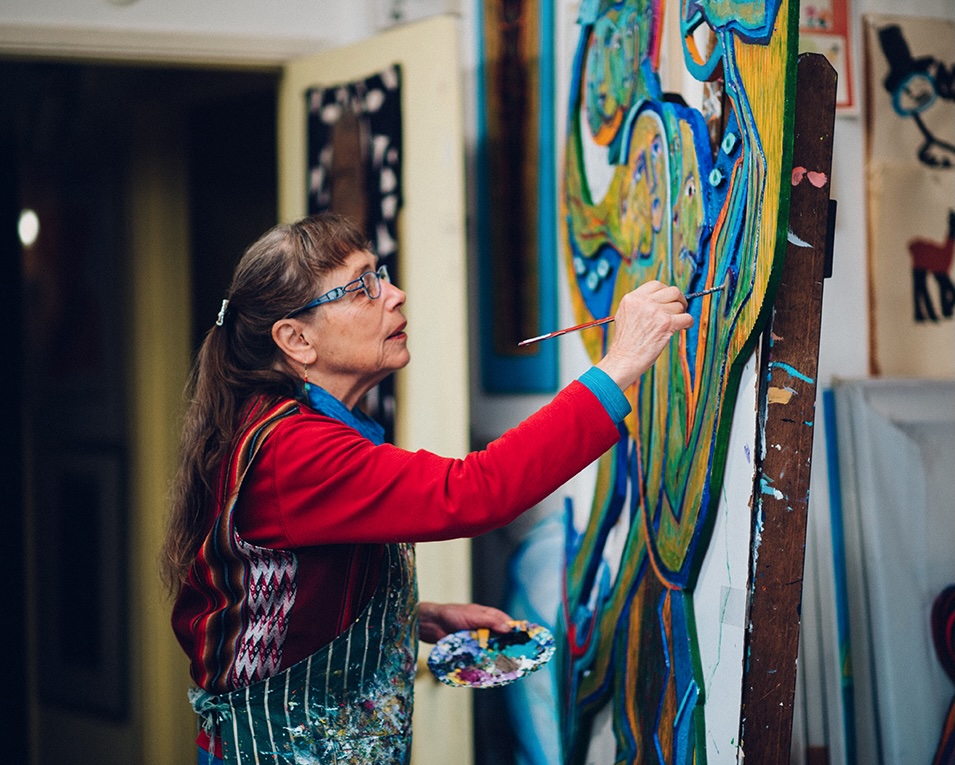
As my age has increased, my art work may have diminished in scope, but not in spirit.
For more than four decades, the sketchbook was my constant companion as I traveled to villages across Asia, Latin America and Africa recording cultural diversity — from rites of passage to food-survival. These sketches inspired hundreds of paintings and prints.
In time, my work evolved from stretched canvases and zinc etching plates to shaped forms. New images came to life on an unlikely surface: plywood panels. The tools in my Oregon studio now included the band saw, jig saw, drills and routers — along with large jars of acrylic paint.
My collaboration with Heifer International (2004-2009) was the catalyst. Inspired by their mission “to work with communities to end hunger and poverty,” I traveled and sketched at project sites from Cambodia to Peru, capturing the lives of local pastoralists with their families and herds.
When Heifer requested a mural for its Education Center, I shifted direction: I let go of direct wall painting and experimented, instead, with shaped, routed, and painted wood panels. A year later, 28 panels of “Dreaming Cows,” approximately 7 feet tall by 4 feet wide, left my Oregon studio for Heifer’s headquarters in Little Rock, Arkansas.
In the years since, I have remained as committed as ever to art that resonates with humanity and social responsibility, but the messengers are now closer to home.
I have followed migrant and seasonal farm workers in the pear orchards, vineyards, and small farms near where I live. I have followed, too, migrants at the Mexican border, resulting in totems, inspired by Native American Totem Poles, that honor the resilience of these desperate travelers, determined to still rise.
In 2021, as we emerged from COVID insolation, the door in my Ashland studio opened and, unbeckoned, turtles slowly appeared (joining turtles, it turns out, that had appeared in my paintings for decades). Within weeks, they became my symbolic storytellers, migrants of their own making, commenting on the events — from climate change to war — sucking oxygen from the world I knew.
Skill saw in hand, I shaped plywood into a variety of turtle forms. I created depths and textures, where there had been none, with my drill and router. Color came last as the wood-thirsty surfaces absorbed layers of acrylic paint and brought the Turtles to life.
They formed tribes: Personal, Political, and Playful and eventually began to leave home, populating exhibits across Oregon and beyond.
I’ve always believed that paintings, like children, need to grow up and evolve. The past three years, this has been the way with my TURTLES, a patient coexistence. With time and air, they have breathed and expanded. I have too.
Now in my ninth decade as an artist, I hope people find joy and promise in my work, but also questions, questions that need to be resolved for which there are no simple answers, questions that hold our collective future in balance.
More than fifty years ago, I qualified for my first sabbatical from teaching. “’Do something challenging,’ my husband Peter said, and I did. I went to India alone for one month with pen and sketchbook. Peter also advised, ‘Look at people’s connection to their environment—what they plant, harvest, and eat.’ I did that too, and I have never stopped.
A year ago, I took my sketchbook with me to New Zealand to capture and share Māori village life.
What unites the body of work? What pulls us all together is a need to survive. How we coexist depends upon basic components — tilling the earth, forming communities, celebrating the transition of seasons and our rites of passage from birth to death. I yearn for peace in a world where life can blossom and where creative potential allows for “constructing” rather than “deconstructing” as the primary force. My sketches, prints, acrylic paintings, and shaped wood panels often embrace the following themes: spiritual traditions that connect us to our past, present, and future; honoring the earth — plowing, planting, and harvesting; peace that brings an end to conflict and war; and transitions that recognize our life cycle from birth to bonding to ultimately letting go.